Showing posts with label unrealistic. Show all posts

Tuesday, August 26, 2014

On Representation and Sexism in the Media

So I'm sure I can't be the only one who's noticed that in interviews with celebrities, whether on the red carpet or on a talk show, there's an extreme amount of sexism that is obvious from the questions asked by the reporters. Men tend to get the interesting questions- about their career and their experience, their inspirations and motivations, or deep questions about the character they're portraying. Turn the camera on an equally talented female, and half the interview is spent gushing over her outfit- "Where'd you buy your dress?" "How many pairs of shoes did you choose from?" -and if they have time at the end, they ask about their friends, hair, pregnancies, and other things equally irrelevant to the reason she's there on that red carpet. Not that asking them about their personal lives is a bad thing, but I'm sure they're just as eager to share their career experiences with the entire world as the men are. And honestly? All the clothing talk needs to go. If they want to share where they got that disgustingly expensive dress, then by all means, ask them, but it's beyond unfair that women aren't taken seriously as far as slightly deeper questions go.
This is something that really infuriates me. Time and time again, men and women's roles are painted in our media- the men are the talented ones, the trailblazers and innovators, the ones to watch for years to come. The women? Oh, you can watch for that fashion line she's bound to release based off of that gorgeous cerulean ensemble she's wearing. Forget that she's talented and well-thought of enough to be at the Emmys or the Grammys or whatever it is. Apparently the only people interesting enough to talk about their careers and deeper thoughts and experiences are males. Over half of the world's population is female, and there's no reason that it's fair or right to depict women as the airheads whose only valuable contribution to society is whatever they're wearing today. That's not just a wrong perspective, that's destructive and I'd go so far as to call it evil. Cause honestly, I don't think that's too much of an exaggeration. The idea that women are unimportant and uninteresting and only appreciated for their appearances and similar things is an absurd message that is harmful to everybody.

After all, Melissa McCarthy wasn't invited to the Emmys because of that purple dress she wore. And Hayden Panettiere wasn't called in to the red carpet to talk about her pregnancy. Both of these women(and the many others who have faced sexist questions on a very public scale throughout the years) are fabulous actresses, hard workers, and modern innovators, and that is why they were there. Though you couldn't tell that by listening to their interviews. I'm sure they're frustrated by that. I mean, wouldn't you be? They've accomplished great things and worked hard to get this far and the first thing the interviewer asks them to tell the whole world is where they got their shoes.

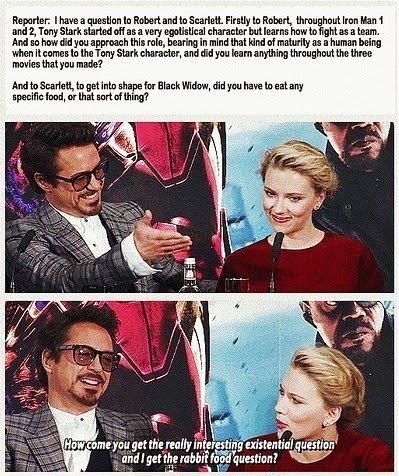
This trope appears just about everywhere in our media. Almost any interview with an actress or other female celebrity will involve questions about their clothes, hair, workout tips, etcetera. Take this interview with Scarlett Jonhansson and Robert Downey Jr.- he gets asked the really interesting, deep question about his character, and she gets asked about how she got in shape. This just goes to show how unfair and ridiculous all of this is, because I mean, not only is this sexist in the extreme, but it's a missed opportunity- both for her to share some of her insights gained from portraying this character and to spice up the interview. The Black Widow is an endlessly interesting and complex
character and the reporter could've asked her an equally intriguing question. And I mean, if you want to focus on the actors' physical traits, why not ask RDJ how he gets his hair to look so fabulous?
What it comes down to, I guess, is that our society needs to stop this ridiculous gender discrimination. People should be judged for their actions, the things they accomplish, and the way they present themselves, not for something they were born with. I hope someday we can get over this and start treating both men and women with equality and not assuming that an individual's potential is diminished or determined by something like gender.
--Oswin

Tuesday, July 29, 2014

Strong Is Beautiful


As we know, gender equality for sports has been a tough issue over the years, weather it's male cheerleading, or women's basketball, I think media has taken its toll, and so has the production behind it. 

Everyday, male and female athletes go about their same routines, getting up early, watching what they eat, and committing to their sports and training, they both have the same amounts of dedication to their sports, regardless of their gender. So why is it that we have so much more respect for male dominant sports rather than we have for women's? It seems as if females are seen as non-violent, emotional figures while men are seen as tough and aggressive.

It always seems that women get the shorter end of the stick when it comes to athletics. The Men's Olympic soccer team flies business class to their games, whereas the women fly coach. Apparently we don't play as well, sell enough, or overall look as good as men do in sports. We're 45 years into the title IX bill, and us women are still judged on how we look when we play rather than how we play. I feel like too many sports companies try to make women's sports more appealing. Companies are always looking for a way to feminize gear and make it more appealing to men. I play volleyball, and I want to feel good about how I look when I play, but not judged on how short my spandex is.
Clara Hughes, an olympic speed skater
participating in a mostly male-dominated sport
Even aside from the required wear there's the actual playing. Some sports require less contact and strength between women in the sports whereas the men are encouraged to push and shove and get aggressive. Many of these rules apply to baseball/softball, hockey, and lacrosse. Overall even more people are upset over the money male athletes make over female athletes. It is shown that men make a considerate amount more than their female counterparts when it comes to athletics, and that even male teams are more prone to having a larger budget increase than female teams. We have made great strides in the 21st century on showing more and more women athletes  on TV, yet we still see more male sports coverage on TV   than woman's.

It has also come to be that we have pushed certain sports into the specific men's/women's sports category, like labeling volleyball, tennis, track, gymnastics, and cheer, as being female sports, and basketball, wrestling, football, soccer, and baseball as male sports. Even though it seems that some of these sports appeal to a certain type of gender, it still doesn't mean we have to discourage kids from participating in the sport they love, just because of some silly stereotypes. On TV it bothers me that when portraying female cheerleaders, volleyball players, etc, it shows them as sexy, catty girls who are bullies, and have no faith in their sports. Whereas the males are dedicated, and ready to face whatever comes in their way. When the media focuses on female sports, it is usually on ones that society identifies as feminine. We stereotype the female gender in traditional female sports. Why are us women compared against each other in appearance, and not in performance, skill, and dedication? Masculinity comes in all shapes and sizes, and you can still be a pretty face while being a hard-working athlete.

WTA's "Strong is Beautiful" campaign
This is just my opinion, and I can only hope that in the future, us women won't be cheering on the sidelines, or sewing the team uniforms, but actually playing the game, like we are now.

~ Governess Bob

Sunday, June 15, 2014

The Stereotypical Media Setting

This post generally relates to my last one, and I’m trying to keep it different, so bear with me! This is a media issue that has bothered me for a long time now, and it’s really hard to watch a movie or TV show without seeing this. Unfortunately it’s everywhere and anywhere. So here it is.

 One of the things that bothers me in movies, TV shows, books, etc, is that the usual setting is a fancy house in California, or some high class setting with privileged people who have problems with their life. Now I know that many shows are filmed in LA, a fancy area, or a movie studio; but it seems like every show has lost the interest to portray what real people look like.

America does consist of many upper class people, and it appears that the point that studios are trying to prove is “The American Dream.” Is it a staple for films to portray people always aiming for things bigger and better? As I addressed in my last post, media seems to think America’s definition of dreams is just material wealth, and apparently that’s the way we like it. Even in kids movies you see kids living in nice houses with lawyer parents and country club lives, and think, “I sure don’t relate to them.” Even in TV shows trying to portray a middle class family, it always comes out as high-class.

Take commercials for example. Even though a nice life in a nice house is what some Americans want, it still doesn’t mean that you have to flaunt it with your extravagant things. It seems that every commercial is based in a fancy mansion with perfect families and lives. Too many car commercials are showing rich businessmen who have trophy wives and good-looking children, and not enough real family interaction. I always prefer the less expensive car brand commercials because of this. I understand that commercials are meant to appeal to people, but how can it appeal to us if it’s so far from the lives we live now?

This is the stereotypical setting for a car commercial. “Show off and be look cool.” Is what this Lexus ad seems to say.

As I said before, too many kids shows are showing rich families and not enough realistic portrayals. It bothers me that half the shows on Disney Channel show kids with big houses and trendy clothes. I can see the point they are trying to make though: “Work hard and you can achieve your dreams, and be where you want to be.” But somehow I think Disney Channel lacks diversity when it comes to what people want in life. Shows like Jessie, The Thundermans, Lab Rats, Hannah Montana, Liv and Maddie, and more, all seem to have a similar plot line where all the kids live in nice big houses and want to become singers and dancers, and only seek stardom. I do love Disney Channel, and many of their shows are great. I just wish they had a more realistic setting.
It seems that much of Disney Channel’s content only promotes kids who want to be in show business.

As for the books I mentioned, I can’t say that many fit my topic. Books are a whole different world than movies and TV, and there can be much more diversity in books than movies, and maybe that’s why we love them. I think sometimes it’s right to place main characters in a typically wealthy world, and sometimes it’s not. Sometimes people don’t like to be reminded of their lives, and that movies are a way we can escape the harsh realities of life. They are for entertainment, and something we can look up to, no matter if it’s realistic or not. Only some movies are true to life, and those are the ones that make us feel good.


Again, this is just my opinion, and we are all entitled to our own. Sometimes I even think my own opinions are wrong, and that’s the beauty of it. J Thanks for reading!

~ Governess Bob

Monday, June 9, 2014

False Perfection- Unhealthy Images and the Real Problem

Hey guys!
Back in here for my third post already. Times flies, huh? I'm totally enjoying this little venture- it's so much fun to have a platform where I can express my views on this stuff, and to read the opinions of my friends and fellow authors on here. It's been absolutely fantastic so far.
Anyway, I had a hard time deciding on a topic for my post this week. Not because I wasn't sure what I wanted to say- exactly the opposite, actually. I literally have a page-long list of post ideas and it was so hard to choose just one. But that tells you that the one I did choose must be really important, right?

It is. I decided to write about body image in the media, specifically for girls and the way we get  pressured to be absolutely perfect 100% of the time. One of the things that really gets on my nerves is when models for magazines or photoshoots or advertisements or anything are photoshopped to a beyond-attainable point of so-called beauty. I mean, when conventionally gorgeous women have to be retouched and airbrushed and just completely redone with computer fakery, what sort of message are women and girls getting? That they're never going to be beautiful enough, because the images of "beautiful" women that they see are so fake and unrealistic. The amount of digital retouching that models receive make them literally impossible and set a just as impossible standard of beauty for girls.

A couple months back, Lorde tweeted these pictures of herself with the following statement:

"I find this curious- two photos from today, one edited so my skin is perfect and one real. Remember flaws are ok :-)"
I found it really impressive that not only did she feel comfortable enough in her own skin(literally) to go into the public eye big time without trying to be as perfect as possible, but also enough to point out her own flaws under said public eye. However, I also think this just goes to show how twisted society's image of women has become. After years of fake and unrealistic images, this concept of literal perfection has become so ingrained in people's minds that some idiot out there felt the need to take a picture of a confident, gorgeous-without-computer-fakery 17-year-old girl and then edit it to make it perfect, therefore sending her and other girls that what we can be on our own is never going to be enough.

Another example of this idealized concept of complete perfection was found in a controversy with Target a few months ago. On their website, an image of a bikini model was photoshopped to give her the trendy thigh gap that people are being told that they need nowadays. The picture, though, was messed up in an almost comical manner so that the cut that was made to make her legs perfect went up too high and it was obvious that it had been photoshopped. Target responded by saying "it was an unfortunate error and we apologize."
Yeah, right. If you take a close look at the photo above, you can tell that the thigh gap fail was not the only edit. Her arms and legs were also whittled down to toothpick proportions and her waist was edited to be thin and perfect.
Their intention was to photoshop this model and fix every so-called imperfection. They were intending to do the thing that upset everyone, which was to give this model a thigh gap. The only "error" they made was that they accidentally tipped off the public that their swimsuit model wasn't completely and utterly perfect. Their "error" was revealing to the public that, guess what, even their attractive swimsuit models haven't reached the unattainable standard of beauty that society has set up.
In a way, this goof could be viewed as a good thing. It taught everyone who saw it that hey, even this conventionally gorgeous woman isn't perfect. Even this woman who gets paid to pose for the camera in a skimpy swimsuit isn't naturally capable of the beauty standards that we're told to live up to, and that probably means that those standards aren't all that attainable.

The main part of this issue that bugs me is that it's not just in the heads of the advertisers and photographers and other people who take roles in this horrible promotion of absolute perfection. When someone is trying to sell something, either a product or a movie or a magazine, they use what they think will appeal to their audience. And then through some form of trial and error they figure out whether or not that really does appeal to their audience, and if it doesn't seem to, they try a different tactic. But if it does, they keep doing that same thing over and over and eventually even amp up the level a little more.

And that's the main problem, isn't it? In a way, it's really just a vicious cycle that no-one's been able to end through all these years. Media makers pick this image of perfection that they think will please their audience, and whether it pleases everyone or not, it's what they see and it gets stuck in their heads. But then the media makers do the same thing again and again and again, because they think it's what pleases us- and even if it doesn't appeal to all of us at first, how can it not? Maybe some of us still don't love it, but because it's what we see over and over, it becomes the norm. We get used to it. And so the media makers never stop, because their job is to sell, and after all these years, perfection has become the thing that does sell. It's a cycle that repeats itself and that will continue for a long time until somebody sticks their foot in the door to stop it. It'll go on until somebody says "no more" and puts a bump in the road. And maybe, just maybe then things will improve. Things might look up then and maybe people will attempt to change the ways that have become so set in stone over the years.

I just hope that, even if all of this doesn't change for years and years, people will start to see the error of these ways and begin to see the true meaning of beauty- the real things we should look up to. Like kindness and generosity and other things that are a little more attainable. And that, I think, is when things will start to change. I just hope it changes before too much damage is caused.

I hope I've managed to inspire you a little bit with these wild opinions of mine and that I haven't been too dreadfully boring. Until next time, lovelies.
~Oswin
Tuesday, June 3, 2014

Work Hard, Get Rich, Do Nothing

The problem with rich people in commercials, is that they’re so unrealistically portrayed, it’s hard to think, “Wow, I could own this product.”  If you’ve ever seen commercials like Lexus, which I’m sure you have, they all have to involve some high-speed chase, or a picture perfect couple going out to eat at a fancy restaurant. “Yep, there goes my hope of having a fancy car,” It seems that they’re just meant for rich businessmen who sit around all day and drink coffee.

One of the new Cadillac commercials stars a self absorbed, rich man who spends his life working all the time so he can buy expensive things. Now this add has become a controversy providing a misguided representation of the American work ethic, and received very critical feedback. The Cadillac ad starred actor Neil McDonough as a rich guy looking out at his pool and pondering why he and other Americans work so hard when people in other countries take off the whole month of August.
Neil McDonough in the Cadillac commercial

He then turns to the camera and gives a vivid monologue while walking around his expensive house. In it, he describes Americans as "crazy-driven, hard-working believers" who do bold things like go to the moon. He ultimately walks out to his new Cadillac ELR hybrid coupe. "It's pretty simple. You work hard, you create your own luck, and you've got to believe anything is possible. As for all the stuff? That's the upside of only taking two weeks off in August. N’est Ce-pas?”

Can we really expect that that’s going to make you want to buy a car? Do they think we want people to turn to look at you and judge you as a snob with nothing but material wealth? Outside of this guy being incredibly annoying, here's a question: Does taking two fewer weeks of vacation guarantee upper-middle-class wealth? Thinking about how many people labor all over the world—here and abroad—and don't enjoy the same opportunities as this guy, this is extremely hard to dismiss. This commercial was aired during the Winter 2014 Olympics, which was a strange choice. The Olympics is supposed to be about celebrating different countries and cultures coming together, not slamming their success and diligence. Since the commercial, there has been a debate between sides, which includes the supporters of the commercial, and vice-versa. Some people have applauded the commercial for a well represented portrayal of America, while most others have criticized its fake ambition.

In order to draw a contrast, Ford copied the theme of Cadillac's commercial in a recent take on their ad. Only it decided to use Pasho Murray, a real woman who founded Detroit Dirt, a company that turns waste into compost and sells it to people who want to create urban gardens.

The woman looks out at a landfill and wonders why Americans aren't more like other countries who buy locally-grown food.

She gives her speech while walking through a local restaurant where she collects food scraps for compost. She says Americans are starting to get more food from local markets because they're "crazy entrepreneurs trying to make the world better."

She then walks out to her Ford C-Max Energi and draws a phrase of her own. "It's pretty simple. You work hard, you believe that anything is possible, and you try to make the world better. You try. As for helping the city grow good, green, healthy vegetables? That's the upside of giving a damn. N'est-ce pas?"

--Governess Bob

Friday, May 23, 2014

“Strong” Female Characters Vs Real Female Characters

The Black Widow near the end of The Avengers
This is a rant about people who try to make strong female characters, and succeed, but make them so stereotypical that they might as well just be unique and squeal when there’s anything remotely dangerous. One of the characters that bothers me is Marvel’s the Black Widow. I do like the Avengers, but the Black Widow is exactly what I’m talking about. She always has perfect hair and makeup, even after she’s been fighting, and she walks around in a tight fitting catsuit that’s unzipped just a little too far, being a perfect Mary Sue character. It always seems like she can do anything. She’s always making witty statements as she dramatically knocks someone out. She’s a character who can actually do something, but she’s really good at pretty much everything. It seems like every female character has to either be wimpy, or has to be able to do everything. Having long hair gets in the way if it isn’t tied back, and if her outfit is designed to be multipurpose, then shouldn’t it have a few pockets? Also, in every movie that she’s in, her hair changes, and it just doesn’t seem realistic that she has time to either straighten or curl her hair everyday, and even if she did, her hair would get messed up at the end. If you’ve been fighting aliens for hours, you’re not going to be pretty, you’re just going to need a shower and a hospital. The Black Widow, however, still has great hair and makeup, with only a small cut on her lip and a bit of blood on her forehead, and just a little bit of dust. I wish that people would just get over the fact that people, especially women, need to look nice all of the time, or be laughed at. Sure, it would be nice if you could come back from a day of hard work, whether it’s defending earth from aliens, or something more ordinary, and look perfect, but that’s just not going to happen.
Another character that I don’t like is Melinda May from Marvel’s Agents of S.H.I.E.L.D.. Melinda May is almost an exact copy of the Black Widow, but with a different back story, a slightly changed personality, and not as well known. However, she still is highly skilled in martial arts, can still win any evenly matched battle, and always looks perfect. In my opinion, Melinda May is worse than the Black Widow, because at least the Black Widow doesn’t wear heels, and never tried to put stitches in her own shoulder because she was tough.
Merida with a realistically dirty and torn dress
What my point is, is that all female characters seem to all be idealized, and something that no one could ever live up to. Maybe, if you trained for years, you could be good at martial arts while wearing high heels, but your hair just isn’t going to look good if you’ve been in combat, unless you put so much hair spray in it that it can’t move, which means you can’t dramatically peer out through a curtain of hair. A character that I do like, however, is Merida from Brave. I know, big surprise. In case you haven’t guessed yet, we really like Disney princesses. Merida actually has a personality, is sometimes selfish, and doesn’t always win every battle. She also can do things, and won’t just wait for a handsome prince to solve all of her problems either, and she doesn’t look perfect after she falls off of her horse. Her hair does still look the same before and after, but since it’s so curly, it’s still realistic. I really like it when characters aren’t either perfect or weak, whether it’s in their personality, their looks, or both. People need to stop making everyone seem perfect, and start making them real. It would probably make many more people happy, which would be good for business, so logically it makes more sense to have more realistic characters.
--Luna Lovegood

Sunday, May 4, 2014

Of Cardboard Boxes and Unhealthy Expectations from Society

Hey there you lovely people from potentially over eight different countries! (Yep, that's right, eight. One of which I didn't know existed until I noticed that someone from that country had viewed this blog.)

I'm gonna tackle a rather broad but also complex issue here, and one that I could write a book on- sexism, and, more specifically, the sexist standards that society and the media have set up for women. (This is a rather lengthy rant. You've been warned.)

There are so many stereotypes about women in the media, but what I want to get at isn't so much the specific stereotypes within media so much as the stereotype- society's expectations and everything that we're expected to be, and how those expectations are sustained by the media. We have to be pretty enough, smart enough. We have to be gentle or aggressive or sexy or quiet or whatever it is society wants us to be. The worst part is, if we have any two things we aspire to be that- gasp -don't both fit inside of one of society's pretty little cardboard boxes, then people will be poking us with their pencils and shouting us down until we conform into one single mold.

And that idea that everyone has to fit into one particular mold is only helped along by the media. I mean, come on, when have you ever seen a character in mainstream media who instantly reminds you of a real person you know? Almost never, because we feel the need to be the same as everyone else. TV shows and such don't write themselves- they're written by people, and that's why the majority of characters in the media are so extremely unrealistic. We're all so insecure because we feel this need to be squished into a box, so the people who write the media portray that in their writing.

When have you seen a celebrity who's simply comfortable with being who they are in front of the world and doesn't feel the need to change or enhance who they are with plastic surgery and fancy clothing and false personalities? Never, right? That's because all of this surgery and makeup and fakeness is brought upon us (sometimes by ourselves) to make us conform to one mold.

I think we can all agree that this is an issue for everyone, but especially so for women and girls. It makes me so mad when a little girl who's still trying to learn who she is gets pushed around and manipulated so she'll grow up to be exactly what society thinks a woman should be. If your daughter prefers "boyish" colors like blue and green, then the alarm bells go off. Smother her with purple and pink, otherwise she won't grow up to be like "other" women. Even if she does fit some of society's requirements for a woman, she has to stay exactly within that little pinprick-sized center of balance. She can't be glamorous and be into sports and enjoy being active. She can't be a good student and a social butterfly.

Y'know, it's kind of like when women were forced to wear corsets way back when. Someone developed this twisted mental image that all women had to look a certain way, and forced this device upon society that forced all women to conform, even though it was uncomfortable and literally oppressing. Not only is that an example to prove my point, but it also fits as a perfect analogy over the entire issue.

I guess I'll end this with a quote from one of my favorite actresses, Alice Eve from Star Trek: Into Darkness. Some idiot interviewer asked her a stupid question and she gave a great answer.


So yeah, this is exactly what I've been trying to get to through this entire rant. There's a certain list of requirements that we have to stick to. Because we're women, we get judged if we do anything that doesn't live up to society's expectations of what a woman should be.

Anyway, it's a complex issue and I don't know how to resolve it for you guys or myself. I was fortunate enough to be raised by parents who taught me that I can be anything that I want to be, regardless of my gender, but I know that wasn't and isn't the case for so many. Basically, I just think that no one should be told what they can't or should do just because of something they were born with. I think it's fair to judge everyone based on their merit as a person and not by their gender, or to dig deeper, their race or their culture or their financial class. I think everyone should be allowed to pursue their passions and be what they want to, regardless of any physical aspects or things they can't help otherwise.

I know this isn't so much an issue in the media as it is an issue in the whole world, but it's definitely one that is displayed in and is made worse by the media.

Hope you liked this little rant, and I hope I've inspired you a bit with my own opinions.
~Oswin

Thursday, May 1, 2014

Wake Up Call

Rose Tyler in "Rose"
Hey guys! This is my first post and, as my AP exams are fast approaching, I will devote this post to sleep - and more importantly, though certainly less pleasant - waking up.

Now, I'm sure I'm not the only one who notices this, but whenever I see a TV show or a movie, when a character wakes up they're a little ball of radiant sunshine with perfect makeup and hair. Occasionally, I'll see a character wake up like an actual human, like in Frozen and in season one of Doctor Who, but much more often I see characters waking up unrealistically. Don't get me wrong, I understand most TV shows and movies are supposed to be fiction. Still, sometimes it's nice to see some reality in the characters.

All of these images in the media suggest that girls should be wearing makeup to bed and that it's normal to look perfect waking up. But let's be honest, if you wore makeup to bed you'd get it all over your pillow! Girls don't have to look good every single moment of the day, and I wish the media would realize this. Viewers don't mind seeing real humans occasionally! It helps audiences to identify with the character. Anyway, no one's going to be watching you while you sleep(at least I hope so), and if there was someone you should call the police and have them drag the creeper off to jail(ahem, Bella).
Anna from Frozen looking like an actual human
waking up in the morning

So, I guess what I'm trying to get at is that characters don't have to be perfect. No one's perfect and that's okay. Imperfections in a character just make that character seem more real.  But the media often is telling us that it's not okay to be imperfect, not okay to look and act the way we are. This is a harmful message. And though, most people probably don't feel insecure about the way they wake up, these images do make us feel insecure about our imperfections, and that is not okay.

-- Captain Sarah Jane