Showing posts with label Oswin. Show all posts

Tuesday, August 26, 2014

On Representation and Sexism in the Media

So I'm sure I can't be the only one who's noticed that in interviews with celebrities, whether on the red carpet or on a talk show, there's an extreme amount of sexism that is obvious from the questions asked by the reporters. Men tend to get the interesting questions- about their career and their experience, their inspirations and motivations, or deep questions about the character they're portraying. Turn the camera on an equally talented female, and half the interview is spent gushing over her outfit- "Where'd you buy your dress?" "How many pairs of shoes did you choose from?" -and if they have time at the end, they ask about their friends, hair, pregnancies, and other things equally irrelevant to the reason she's there on that red carpet. Not that asking them about their personal lives is a bad thing, but I'm sure they're just as eager to share their career experiences with the entire world as the men are. And honestly? All the clothing talk needs to go. If they want to share where they got that disgustingly expensive dress, then by all means, ask them, but it's beyond unfair that women aren't taken seriously as far as slightly deeper questions go.
This is something that really infuriates me. Time and time again, men and women's roles are painted in our media- the men are the talented ones, the trailblazers and innovators, the ones to watch for years to come. The women? Oh, you can watch for that fashion line she's bound to release based off of that gorgeous cerulean ensemble she's wearing. Forget that she's talented and well-thought of enough to be at the Emmys or the Grammys or whatever it is. Apparently the only people interesting enough to talk about their careers and deeper thoughts and experiences are males. Over half of the world's population is female, and there's no reason that it's fair or right to depict women as the airheads whose only valuable contribution to society is whatever they're wearing today. That's not just a wrong perspective, that's destructive and I'd go so far as to call it evil. Cause honestly, I don't think that's too much of an exaggeration. The idea that women are unimportant and uninteresting and only appreciated for their appearances and similar things is an absurd message that is harmful to everybody.

After all, Melissa McCarthy wasn't invited to the Emmys because of that purple dress she wore. And Hayden Panettiere wasn't called in to the red carpet to talk about her pregnancy. Both of these women(and the many others who have faced sexist questions on a very public scale throughout the years) are fabulous actresses, hard workers, and modern innovators, and that is why they were there. Though you couldn't tell that by listening to their interviews. I'm sure they're frustrated by that. I mean, wouldn't you be? They've accomplished great things and worked hard to get this far and the first thing the interviewer asks them to tell the whole world is where they got their shoes.

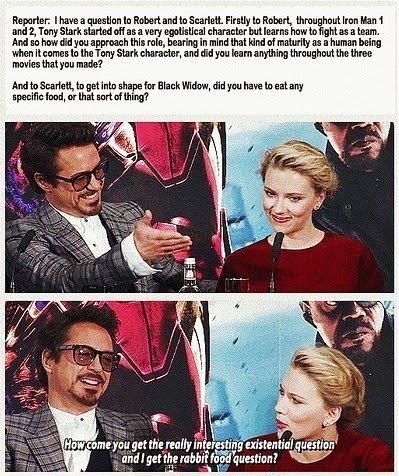
This trope appears just about everywhere in our media. Almost any interview with an actress or other female celebrity will involve questions about their clothes, hair, workout tips, etcetera. Take this interview with Scarlett Jonhansson and Robert Downey Jr.- he gets asked the really interesting, deep question about his character, and she gets asked about how she got in shape. This just goes to show how unfair and ridiculous all of this is, because I mean, not only is this sexist in the extreme, but it's a missed opportunity- both for her to share some of her insights gained from portraying this character and to spice up the interview. The Black Widow is an endlessly interesting and complex
character and the reporter could've asked her an equally intriguing question. And I mean, if you want to focus on the actors' physical traits, why not ask RDJ how he gets his hair to look so fabulous?
What it comes down to, I guess, is that our society needs to stop this ridiculous gender discrimination. People should be judged for their actions, the things they accomplish, and the way they present themselves, not for something they were born with. I hope someday we can get over this and start treating both men and women with equality and not assuming that an individual's potential is diminished or determined by something like gender.
--Oswin

Friday, July 4, 2014

"We're Such Nerds"- How It's No Longer "In" to Be Smart

Hey guys!
So today I'm going to deviate slightly from my usual theme and write something that is nothing like my other posts. As much as I love ranting about female representation in the media and dissing sexism and that sort of thing, I felt like this was a post that really needed to be written. And, well, here I am.

The idea for this post came a couple months ago when I was texting one of my close friends. We were in deep discussion about one of the things that consumes the majority of our time- homework. It wasn't one big pity party in which we complained about how much homework we had to do (I say that because that has happened plenty of times), but a rather animated conversation about new things we had learned. My friend got particularly excited to tell me about a new concept she had come across in math and I was telling her about an essay I had read in my American History course. After a good half-hour of carrying on in this manner, we agreed that we were total nerds.
That happened again a few weeks later. I spent hours with the same friend trying to identify a tree together via Facebook and we were thrilled a few days after when we finally figured it out. And again- "we're such nerds."
But that kinda got me thinking. Sure, we kind of are nerds, but why do we have to use that term in a self-deriding manner? What's wrong with being excited about new insights into common events in history? Is it a problem to be intrigued by a new concept that should be somewhat helpful in the future? Absolutely not. However, I think the main reason that we felt that we had to "apologize" for our enthusiasm for learning with a derogatory word like "nerd" is because I doubt society would agree with my above statements.

In a world of "can't even" and "lol" and "idk", could it be more obvious that we, as a society, have decided that it's not cool to be smart anymore? We feel the need to bring down our level of intelligence in a very public way with text talk and hashtags, and we pin labels like "nerd" on anyone who shows a genuine interest in being something more than that. I'm not saying you're an uneducated animal if you're into that stuff- I, for one, admit to being guilty to the more-than-occasional abbreviation and intentionally horrid grammar while on the internet -but it seems pretty ridiculous to me that we've adopted this tragically unintelligent way of communication as the norm. It's alright as a way of communication if it feels more convenient, but I see no reason why we feel like we have to paint ourselves as less intelligent to be "cool".

There's a spoken-word poem I really love written by Taylor Mali, a high-school English teacher who also decided to write really awesome poems like this one. It really conveys what I'm trying to say (probably more adequately than I can myself).
It describes the way we've fallen into this awful way of speaking, about how it's no longer the cool thing to sound like you know what you're saying. The whole poem mimics the infamous internet tone, making statements sound like questions and inserting unnecessary fillers such as "like" and "y'know".

The end of the poem challenges its listeners to speak with conviction- to "say what you believe in a manner which bespeaks the determination with which you believe it". We have all this ridiculous little abbreviations and slang words that we use to do the exact opposite of that (however inadvertently). If we happen to be some of those whose sense of wonder and enthusiasm for learning still remains through this universe filled with an overwhelming sense of unintelligence, then why shouldn't we wear that proudly? Why does "nerd" have to be a bad thing? Why do we have to apologize for what we know when our own knowledge only adds to the positive things we can contribute to the world?

I guess what I'm trying to get at is that creating a culture where feel pressure and pressure others to act(and sometimes, consequently become) unintelligent seems counter-productive to creating a more enlightened society. And that starts with being proud of our nerdiness- not apologizing when we're so excited about FINALLY identifying that stupid tree, or getting a difficult math problem right. We shouldn't be embarrassed to be dedicated to our education, and shouldn't be ashamed of a precious love for learning. Why does nerd have to be an insult, anyway?
--Oswin

Monday, June 9, 2014

False Perfection- Unhealthy Images and the Real Problem

Hey guys!
Back in here for my third post already. Times flies, huh? I'm totally enjoying this little venture- it's so much fun to have a platform where I can express my views on this stuff, and to read the opinions of my friends and fellow authors on here. It's been absolutely fantastic so far.
Anyway, I had a hard time deciding on a topic for my post this week. Not because I wasn't sure what I wanted to say- exactly the opposite, actually. I literally have a page-long list of post ideas and it was so hard to choose just one. But that tells you that the one I did choose must be really important, right?

It is. I decided to write about body image in the media, specifically for girls and the way we get  pressured to be absolutely perfect 100% of the time. One of the things that really gets on my nerves is when models for magazines or photoshoots or advertisements or anything are photoshopped to a beyond-attainable point of so-called beauty. I mean, when conventionally gorgeous women have to be retouched and airbrushed and just completely redone with computer fakery, what sort of message are women and girls getting? That they're never going to be beautiful enough, because the images of "beautiful" women that they see are so fake and unrealistic. The amount of digital retouching that models receive make them literally impossible and set a just as impossible standard of beauty for girls.

A couple months back, Lorde tweeted these pictures of herself with the following statement:

"I find this curious- two photos from today, one edited so my skin is perfect and one real. Remember flaws are ok :-)"
I found it really impressive that not only did she feel comfortable enough in her own skin(literally) to go into the public eye big time without trying to be as perfect as possible, but also enough to point out her own flaws under said public eye. However, I also think this just goes to show how twisted society's image of women has become. After years of fake and unrealistic images, this concept of literal perfection has become so ingrained in people's minds that some idiot out there felt the need to take a picture of a confident, gorgeous-without-computer-fakery 17-year-old girl and then edit it to make it perfect, therefore sending her and other girls that what we can be on our own is never going to be enough.

Another example of this idealized concept of complete perfection was found in a controversy with Target a few months ago. On their website, an image of a bikini model was photoshopped to give her the trendy thigh gap that people are being told that they need nowadays. The picture, though, was messed up in an almost comical manner so that the cut that was made to make her legs perfect went up too high and it was obvious that it had been photoshopped. Target responded by saying "it was an unfortunate error and we apologize."
Yeah, right. If you take a close look at the photo above, you can tell that the thigh gap fail was not the only edit. Her arms and legs were also whittled down to toothpick proportions and her waist was edited to be thin and perfect.
Their intention was to photoshop this model and fix every so-called imperfection. They were intending to do the thing that upset everyone, which was to give this model a thigh gap. The only "error" they made was that they accidentally tipped off the public that their swimsuit model wasn't completely and utterly perfect. Their "error" was revealing to the public that, guess what, even their attractive swimsuit models haven't reached the unattainable standard of beauty that society has set up.
In a way, this goof could be viewed as a good thing. It taught everyone who saw it that hey, even this conventionally gorgeous woman isn't perfect. Even this woman who gets paid to pose for the camera in a skimpy swimsuit isn't naturally capable of the beauty standards that we're told to live up to, and that probably means that those standards aren't all that attainable.

The main part of this issue that bugs me is that it's not just in the heads of the advertisers and photographers and other people who take roles in this horrible promotion of absolute perfection. When someone is trying to sell something, either a product or a movie or a magazine, they use what they think will appeal to their audience. And then through some form of trial and error they figure out whether or not that really does appeal to their audience, and if it doesn't seem to, they try a different tactic. But if it does, they keep doing that same thing over and over and eventually even amp up the level a little more.

And that's the main problem, isn't it? In a way, it's really just a vicious cycle that no-one's been able to end through all these years. Media makers pick this image of perfection that they think will please their audience, and whether it pleases everyone or not, it's what they see and it gets stuck in their heads. But then the media makers do the same thing again and again and again, because they think it's what pleases us- and even if it doesn't appeal to all of us at first, how can it not? Maybe some of us still don't love it, but because it's what we see over and over, it becomes the norm. We get used to it. And so the media makers never stop, because their job is to sell, and after all these years, perfection has become the thing that does sell. It's a cycle that repeats itself and that will continue for a long time until somebody sticks their foot in the door to stop it. It'll go on until somebody says "no more" and puts a bump in the road. And maybe, just maybe then things will improve. Things might look up then and maybe people will attempt to change the ways that have become so set in stone over the years.

I just hope that, even if all of this doesn't change for years and years, people will start to see the error of these ways and begin to see the true meaning of beauty- the real things we should look up to. Like kindness and generosity and other things that are a little more attainable. And that, I think, is when things will start to change. I just hope it changes before too much damage is caused.

I hope I've managed to inspire you a little bit with these wild opinions of mine and that I haven't been too dreadfully boring. Until next time, lovelies.
~Oswin
Sunday, May 4, 2014

Of Cardboard Boxes and Unhealthy Expectations from Society

Hey there you lovely people from potentially over eight different countries! (Yep, that's right, eight. One of which I didn't know existed until I noticed that someone from that country had viewed this blog.)

I'm gonna tackle a rather broad but also complex issue here, and one that I could write a book on- sexism, and, more specifically, the sexist standards that society and the media have set up for women. (This is a rather lengthy rant. You've been warned.)

There are so many stereotypes about women in the media, but what I want to get at isn't so much the specific stereotypes within media so much as the stereotype- society's expectations and everything that we're expected to be, and how those expectations are sustained by the media. We have to be pretty enough, smart enough. We have to be gentle or aggressive or sexy or quiet or whatever it is society wants us to be. The worst part is, if we have any two things we aspire to be that- gasp -don't both fit inside of one of society's pretty little cardboard boxes, then people will be poking us with their pencils and shouting us down until we conform into one single mold.

And that idea that everyone has to fit into one particular mold is only helped along by the media. I mean, come on, when have you ever seen a character in mainstream media who instantly reminds you of a real person you know? Almost never, because we feel the need to be the same as everyone else. TV shows and such don't write themselves- they're written by people, and that's why the majority of characters in the media are so extremely unrealistic. We're all so insecure because we feel this need to be squished into a box, so the people who write the media portray that in their writing.

When have you seen a celebrity who's simply comfortable with being who they are in front of the world and doesn't feel the need to change or enhance who they are with plastic surgery and fancy clothing and false personalities? Never, right? That's because all of this surgery and makeup and fakeness is brought upon us (sometimes by ourselves) to make us conform to one mold.

I think we can all agree that this is an issue for everyone, but especially so for women and girls. It makes me so mad when a little girl who's still trying to learn who she is gets pushed around and manipulated so she'll grow up to be exactly what society thinks a woman should be. If your daughter prefers "boyish" colors like blue and green, then the alarm bells go off. Smother her with purple and pink, otherwise she won't grow up to be like "other" women. Even if she does fit some of society's requirements for a woman, she has to stay exactly within that little pinprick-sized center of balance. She can't be glamorous and be into sports and enjoy being active. She can't be a good student and a social butterfly.

Y'know, it's kind of like when women were forced to wear corsets way back when. Someone developed this twisted mental image that all women had to look a certain way, and forced this device upon society that forced all women to conform, even though it was uncomfortable and literally oppressing. Not only is that an example to prove my point, but it also fits as a perfect analogy over the entire issue.

I guess I'll end this with a quote from one of my favorite actresses, Alice Eve from Star Trek: Into Darkness. Some idiot interviewer asked her a stupid question and she gave a great answer.


So yeah, this is exactly what I've been trying to get to through this entire rant. There's a certain list of requirements that we have to stick to. Because we're women, we get judged if we do anything that doesn't live up to society's expectations of what a woman should be.

Anyway, it's a complex issue and I don't know how to resolve it for you guys or myself. I was fortunate enough to be raised by parents who taught me that I can be anything that I want to be, regardless of my gender, but I know that wasn't and isn't the case for so many. Basically, I just think that no one should be told what they can't or should do just because of something they were born with. I think it's fair to judge everyone based on their merit as a person and not by their gender, or to dig deeper, their race or their culture or their financial class. I think everyone should be allowed to pursue their passions and be what they want to, regardless of any physical aspects or things they can't help otherwise.

I know this isn't so much an issue in the media as it is an issue in the whole world, but it's definitely one that is displayed in and is made worse by the media.

Hope you liked this little rant, and I hope I've inspired you a bit with my own opinions.
~Oswin

Wednesday, April 9, 2014

3 Book Recommendations That Will Blow Your Mind

Hello there!
Oswin Oswald here. First post EVER. I should be totally honored, right?
I am. Which is why I am going to shower you readers with positive things instead of a lengthy rant.
So today I’m going to give you THREE AWESOME BOOK RECOMMENDATIONS.
But since this is a blog about tackling media issues, I am going to tackle a big one. Each of these books contains a positive female protagonist, a realistic one who isn't a breathing stereotype.
So now, my dear readers, without further ado, I present to you(in no particular order):

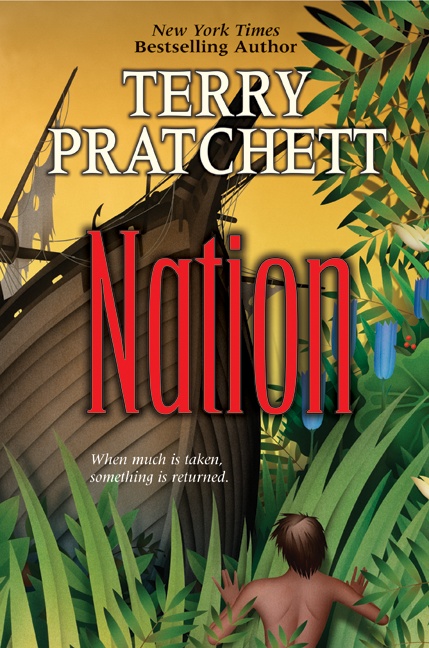
1. Nation, by Terry Pratchett
Nation starts back in the olden days. There's a pandemic going on in England that's wiped out the royal family, and almost all of the living heirs to the throne. One of the two still living is a 12-year-old girl named Daphne who's in the middle of the Southern-Pelagic ocean, traveling with a religious captain and his foul-mouthed sailors. The other living heir is her father, who's trying to find her after a natural disaster takes place.
So these two living heirs are nowhere to be found, which is a problem, because one of them has to set foot on English soil within a decent period of time after the monarch’s death. 

Meanwhile, on a Southern-Pelagic island, a boy named Mau is sailing back to his home island after having completed a coming-of-age ritual. He traveled to the Island of The Boys and is heading back home in his adorable little canoe when The Wave hits. (Read as: tsunami) 
He manages to stay alive because he's far enough away from the worst of it, but when he arrives at The Nation(his island), he finds that his entire island has been wiped out. And there's also something that wasn't there before- Daphne's ship. Yep.
Aaaaaand... let the story begin. Mau and Daphne can't understand each other, but they have to learn to because they're all the other's got. Nation is coming-of-age novel filled with humor, insights, incredible realizations and character growth, realistic and lovable characters and also pure awesomeness.
Daphne's the realistic, well-intending female protagonist. She's awkward, funny, practical, brave, but also very, very scared. She doesn't fit any one stereotype and reminds me of real people I've seen around me. All-in-all, it's a fabulous book that everyone should read.


2. Icefall, by Matthew J. Kirby
I haven't read this one in a while, but it's on my shelf and it's a fabulous read. It takes place in a time when vikings frolicked and somewhere near Greenland. Probably.
Solveig, a 13-14-something-year-old girl, is trapped with her siblings in an unbreakable ice fortress. She and her brother and sister(and a lot of restless soldiers) are anxiously waiting for news of their father(the king)'s victory at war. But as the seasons go on and the icy walls don't break, everyone begins to turn on each other. There's a traitor in their midst, someone who seeks to bring down the entire kingdom.
Solveig and her siblings struggle to survive the claustrophobia of being a prisoner of time, and also to find the traitor themselves before he or she gets restless and decides to end it right there.
Solveig is another utterly realistic character. She's scared but ultimately being brave in the end. She's kind but has her limits, and we see her reach them in the book. One of the main themes of this book is self-discovery, because Solveig, the over-looked middle child who isn't pretty like her sister and can't become a great warrior like her brother, feels like she just passes through her father's gaze. Through all the craziness of ice and traitors, she discovers her talent, finds out who she has the capacity to be.

3. The Worry Week, by Anne Lindbergh
This one's a little bit younger than the others, but a great read for everyone. I read it when I was ten or eleven and still love it.
Anyway, it's about a girl named Allegra and her two sisters who are visiting their family's vacation home in Maine when a family tragedy halts their vacation abruptly. Their parents have to go to a funeral and are going to dump their daughters off at their aunt's house in Boston. But they'd much rather stay on the island than at their aunt's house, so they come up with a plan to trick their parents and their aunt and stay at the island on their own.
It's a wonderful book about sisters and adventures and honesty and one of the main reasons I like it is because it's about a family working together and it's really just a lovely story. Oh yeah, and Allegra's awesome too because, again, she doesn't fit any stereotypes. She's smart, but makes mistakes and doesn't think everything through all the time. She's kind and patient with her sisters but gets exasperated with them like you'd expect. So really, if you just want a quick, fun read, this is your book.

Okay, that ended up being longer than I expected. Anyhow, I hope you enjoyed this post and will find a new favorite in one of these books(if you haven't read them already!).
--Oswin Oswald